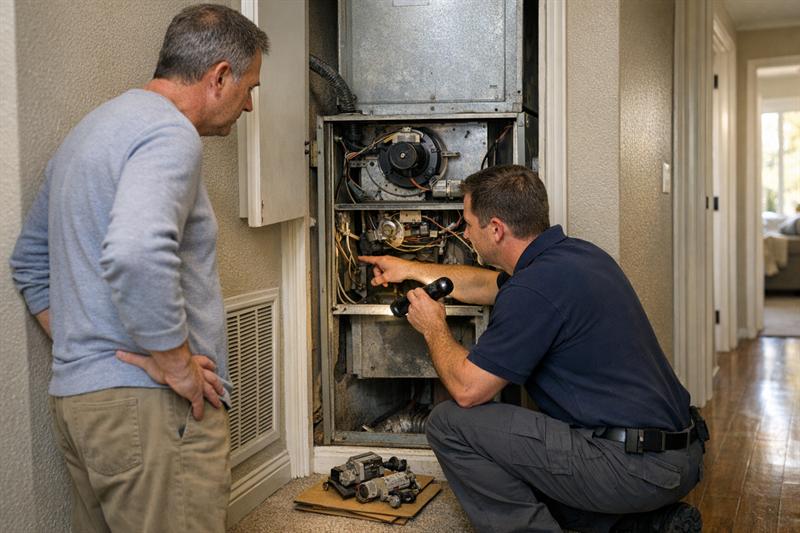
Quick Answer: If your furnace is breaking down often, driving up energy bills, or nearing 15–20 years old, replacement is usually the more practical long-term decision. Newer systems with isolated issues are often worth repairing. Making the wrong call can lead to repeat costs, unreliable heat, and a higher chance of failure when you need it most.
The Real Question: Fix It or Start Fresh?
This decision usually comes up when something is already wrong. The system is not heating properly, making noise, or has stopped working altogether. In many cases, a repair is possible, but that does not always make it the right choice.
One of the most expensive patterns is continuing to repair a furnace that is already wearing out. At first, the repairs seem manageable. Over time, they become more frequent and less effective. That is where costs build and reliability drops.
The goal is not just to restore heat today. It is to avoid ongoing problems that keep coming back.
How Long Do Furnaces Typically Last?
Most furnaces last about 15 to 20 years. Actual lifespan depends on how the system has been maintained, how often it runs, and how well it was installed.
- Regular maintenance helps systems run longer and more efficiently
- Heavy seasonal use increases wear on components
- Installation quality affects how evenly the system ages
Age does not automatically mean replacement, but it does change how repairs should be viewed. Once a system passes the 15-year mark, it is more likely to develop recurring issues rather than isolated ones.
Basic upkeep, such as changing air filters regularly, supports performance, but it cannot prevent long-term wear inside the system.
Signs Your Furnace Can Likely Be Repaired
Repair is usually the right choice when the issue is limited and the system still has dependable life remaining.
Minor or Isolated Issues
Problems tied to a single part, such as an igniter or thermostat, are often straightforward to fix. This is common in systems that otherwise heat the home consistently.
Furnace Is Less Than 10–12 Years Old
Newer systems are built to run for many years. When a problem shows up early, it is often repairable without affecting long-term performance.
Repair Cost Is Relatively Low
If the repair is small compared to the overall value and condition of the system, fixing it is often the practical move.
Addressing issues early matters. Small problems can spread when ignored, leading to more complex repairs later.
Signs It May Be Time for a Full Replacement
Replacement becomes the better option when the system starts showing patterns of decline rather than one-off problems.
Frequent Breakdowns and Repeat Repairs
If the furnace needs service every season, it may no longer be a stable long-term system. One repair may solve the immediate problem, but another part often fails soon after.
Rising Energy Bills Without Explanation
Older systems tend to lose efficiency over time. They run longer to produce the same amount of heat, which can increase energy use without improving comfort.
Uneven Heating or Poor Performance
When some rooms stay cold while others are warm, the system may be struggling to distribute heat. That can point to wear, airflow problems, or a furnace that is no longer keeping up.
Furnace Age Over 15–20 Years
At this stage, many systems are nearing the end of their usable life. Repairs often become short-term fixes rather than long-term solutions.
If you are noticing these signs:
- Multiple repairs in the past year
- Heating that feels inconsistent or weak
- Energy bills that continue to increase
- A system older than 15 years
the furnace may be reaching the point where replacement is the more reliable solution.
Cost Comparison: Repair vs Replacement
Repairs cost less upfront, but they can add up over time when problems keep returning. Replacement requires a larger initial investment, but it also resets the system and can break the cycle of ongoing fixes.
A common situation is continuing to repair an aging furnace because each individual fix seems manageable. Over several seasons, those costs can start to approach what a replacement would have been, while the system continues to decline.
Older furnaces also tend to run less efficiently. That often shows up as higher monthly energy bills that continue as long as the system stays in service.
The “50% Rule” and Smarter Decision Guidelines
The 50% rule is a simple guideline for evaluating repairs. If the cost of a repair is close to half the cost of a new system, replacement is often the better choice.
But cost alone does not tell the full story. A better way to look at the decision is the overall tipping point:
- How old the system is
- How often it needs repairs
- How much efficiency and performance have declined
This is where many homeowners wait too long. The furnace still turns on, so repairs continue even as performance drops. Eventually, the system stops working altogether, and the decision becomes urgent instead of planned.
Safety Considerations You Shouldn’t Ignore
As furnaces age, internal components wear down. Some problems affect safety as well as performance.
- Cracked heat exchangers
- Combustion issues
- Restricted airflow
These conditions can reduce how safely and effectively the system operates. When these signs appear, it is important to have the furnace checked before continuing normal use.
How a Professional Inspection Changes the Decision
A repair addresses what has already failed. An inspection helps identify the broader condition of the system and whether additional issues are likely.
This is where homeowners can miss the bigger picture. The visible issue gets fixed, but wear across the rest of the system continues. A technician can evaluate key components and how the system is performing as a whole.
Working with a provider offering complete HVAC services can help clarify whether the system still has dependable life left or is nearing replacement.
What Sacramento-Area Homeowners Should Consider
Heating demand in the Sacramento area tends to spike during colder periods rather than stay constant year-round. That creates a pattern where systems that seemed fine earlier can fail under heavier use.
A furnace that has been struggling may finally stop working when temperatures drop. At that point, repairs may no longer be enough, and replacement can become urgent.
Addressing issues early allows for a planned decision instead of reacting to a breakdown.
Conclusion
The real issue is not just choosing between repair and replacement. It is avoiding a cycle of repeated fixes on a system that is already declining. When that happens, costs increase, performance drops, and failure becomes more likely at the worst time.
Once a furnace shows consistent signs of wear, continuing to repair it often leads to more disruption and higher long-term expense.
Newman’s Heating and Cooling approaches this by looking at the full condition of the system, not just the immediate problem. That makes it easier to decide whether a repair is likely to hold or whether replacement is the more reliable path forward.
If your system is showing these patterns, the next step is to schedule an evaluation through furnace repair services or review furnace replacement options before the issue gets worse.
Key Takeaways
- Repair is usually best for newer systems with isolated issues
- Replacement is often the better option for older systems with recurring problems
- Repeated repairs can lead to higher total costs over time
- Declining performance often shows up as uneven heating and higher energy use
- A full system evaluation provides the clearest direction
How Newman’s Heating and Cooling Approaches This Decision
The focus is on solving the problem long term, not just completing a repair. That starts with understanding how the system is performing today and how it is likely to hold up going forward.
A common situation is a furnace that still runs but no longer heats consistently or efficiently. In those cases, continuing to repair the system often leads to more service calls and ongoing frustration.
By evaluating age, repair history, and performance together, the goal is to recommend the option that restores reliable heating and helps avoid repeat issues.
FAQ
Should I repair or replace my furnace?
If the system is newer and the issue is isolated, repair is usually the right choice. If it is older and breaking down repeatedly, replacement is often more practical. A full evaluation helps confirm which direction makes the most sense.
At what age should a furnace be replaced?
Many systems are evaluated for replacement between 15 and 20 years. After that point, repairs often become more frequent and performance tends to decline.
Is it worth fixing a 20-year-old furnace?
In many cases, replacement is the more reliable option. Repairs on systems this old often do not last long and can lead to ongoing costs.
How much should a furnace repair cost before replacing?
If a repair approaches half the cost of a new system, replacement is often the better investment. This helps avoid repeated spending on a furnace that is already wearing out.
What are the most common signs a furnace is failing?
Frequent repairs, uneven heating, rising energy bills, and unusual noises are all signs the system may be declining. These issues usually get worse if left unaddressed.
Can a furnace last 30 years?
Some systems can last that long, but most lose efficiency and reliability well before then. Even if still running, an older furnace is usually worth evaluating for performance and overall condition.